Seaver College Participates for First Time at International Moot Court Competition
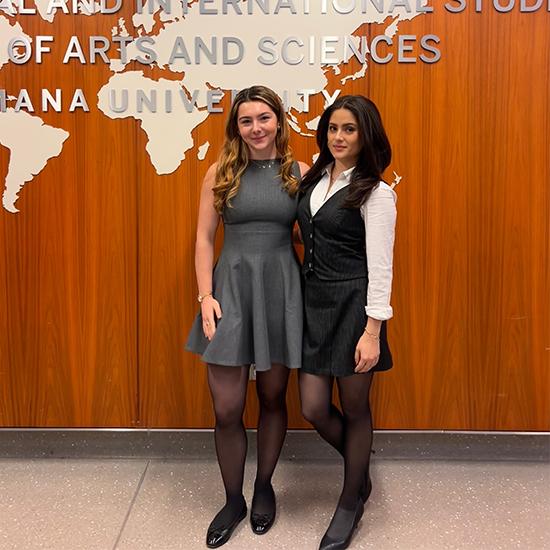
Seaver College students Raquel Casillas and Nikki Quartuccio recently returned from placing in the quarterfinals at the Indiana University Hamilton Lugar Undergraduate International Law (HLI) Moot Court competition. The duo’s feat marked the first time Seaver undergraduates had competed at a collegiate international moot court competition.
“I hope that Nikki and Raquel's participation will set the momentum for Seaver students to compete in future International Court of Justice Moot Court competitions,” says Felicity Vabulas, Blanche E. Seaver Associate Professor of International Studies, who served as the team’s faculty advisor. “They've helped create a playbook that other students can follow to prepare and excel.”
Though a staple in preparation for international law students, moot court competitions are a relatively new event for undergraduates. In its second year of operation, the HLI competition provided the Seaver students an opportunity to apply fundamental concepts of international law as oral advocates. The event consisted of a simulated appellate-level hearing before an international tribunal of judges comprising practicing international lawyers belonging to nations stretching from Belgium to Bangladesh.
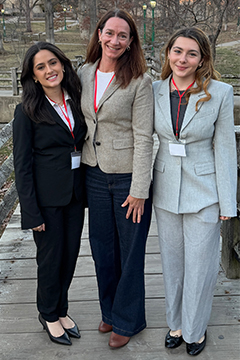 L to R: Casillas, Vabulas, Quartuccio
Each fictional court case was crafted by the event’s organizers with an opportunity for both sides to create compelling arguments. Distinct from mock trial competitions or even graduate-level moot courts, all competitors alternate throughout the course of the competition to argue as both the appellant and respondent.
“We had to think very quickly on our feet, and we made it very far,” says Casillas. “We both came from this perspective: We’re going to do this. We’re an all-girl team. We’re going to show up and show out.”
The case consisted of a dispute over when breakaway states can be recognized by the international community and the conditions under which states can legitimately use force. The breadth of the debate included questions about what responsibility states have to uphold international standards of human rights.
“It was remarkable to watch the students think about these ideas as geopolitical instability was also breaking out in real time," Vabulas adds. She shares that the students’ distinct academic backgrounds, for Casillas, political science and sociology, and for Quartuccio, international studies and economics, provided them with valuable knowledge for the event.
The students’ thorough research and keen debate skills were also on display. For months, the two met every Tuesday night to review their arguments, with preparation work involving close reading of the case and researching relevant precedent. Evidently, their hard work paid off.
“Nikki's attention to detail during the research stage provided the team with innovative oral arguments,” Vabulas continues. “Raquel was singled out in praise by one of the judges for her convincing, passionate, and eloquent approach to the deliberations.”
Both Quartuccio and Casillas plan to pursue law degrees after their graduation. The two consider Seaver’s international studies curriculum to be a valuable asset to any aspiring lawyer, where a global perspective and understanding of international systems can even offer helpful context to domestic affairs.
“Most undergraduate students don’t have the opportunity to take international law courses, let alone compete at a moot court competition,” says Quartuccio. “We were given an incredible venue at which to interact with students at a high academic level.”
SUBSCRIBE TO THE WAVELENGTH
Pepperdine Newsroom's official newsletter for campus updates and top news.
Subscribe