International Studies Professor Felicity Vabulas Awarded the Chadwick F. Alger Prize for New Book on International Organizations

Felicity Vabulas, Blanche E. Seaver Associate Professor of International Studies, has received the International Studies Association (ISA) Chadwick F. Alger Prize for her recent book, Exit from International Organizations, coauthored with Inken von Borzyskowski, professor of international relations at Oxford University. Awarded annually, the ISA Alger Prize recognizes the best book on international organizations.
Vabulas’ research marks the first comprehensive study examining both when and why various countries exit international organizations such as the World Health Organization and the International Labor Organization. Despite public discourse suggesting that international institutions are collapsing, her research reveals that these exits are relatively rare and numbers of withdrawal remain largely consistent over time.
“International organizations help countries cooperate on trade, security, public health, and other global challenges,” said Vabulas. “But states do not always remain members. Our research shows that governments will use exit strategically as a last-ditch attempt to negotiate institutional change.”
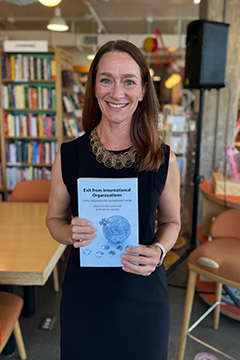 Vabulas wins the Chadwick F. Alger Prize
Gleaning data from a century of history beginning with World War One, Vabulas and von Borzyskowski tracked 198 countries’ interactions with 530 intergovernmental organizations. The pair of researchers found only 500 cases of exits (including withdrawals and suspensions) over those 100 years. In response to these numbers, Vabulas stresses that for any country, “leaving an international organization is very costly.”
Evidence presented within the first portion of Exit from International Organizations confirmed that a peak of these exits occurred during times of geopolitical unrest, such as the Cold War.
The latter part of Vabulas' book examines the consequences of such withdrawals. Reputational damage reigns as a major cost, Vabulas explains, noting that trust from other countries and market actors often lowers when they witness another country’s exit.
Using their wide pool of statistics and subsequent analyses, Vabulas and von Borzyskowski were able to quantify exit-related reputational damage to a degree not previously calculated by researchers in this field. The book also explores suspensions from organizations, which most frequently occur after democratic backsliding or undergoing a coup.
“There’s no global police, so enforcement comes through reputation,” says Vabulas. “Countries that exit institutions are viewed by other countries, as well as international business actors, as being less reliable. There is added political risk, and other countries can become nervous about sending foreign direct investment.”
Vabulas expressed appreciation for having years of data collection and the long process of book drafting recognized with the ISA Alger Prize. The award is named after Chadwick F. Alger, a preeminent 20th-century political scientist and peace researcher.
“It’s heartening to be associated with somebody such as Chadwick Alger, who believed so strongly in diplomacy and the pursuit of the common good,” she adds.
Since joining the Seaver College faculty in 2017, Vabulas has conducted research focusing on international organizations and foreign policy, while teaching courses on various topics related to international studies. She was awarded the Howard A. White Award for Teaching Excellence in 2019 and has served as a devoted faculty advisor for student-led organizations such as Model UN.
“Dr. Vabulas is doing important scholarship on the forces impacting international cooperation," offered Provost Jay Brewster. "Her expansive analysis offers important insight into the stabilizing influences of diplomacy and shared priorities.”
SUBSCRIBE TO THE WAVELENGTH
Pepperdine Newsroom's official newsletter for campus updates and top news.
Subscribe