Regan Schaffer's Servant Leadership Capstone Class Practices the "Homeboy Way"
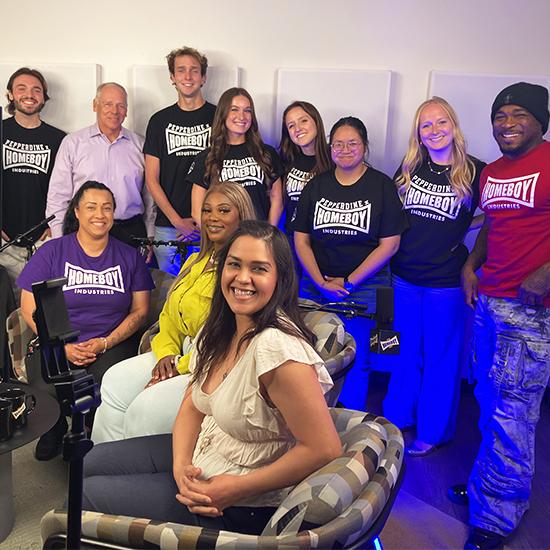
At Seaver College, each business administration major concludes their undergraduate career with a hands-on senior capstone project. After years of studying theory on management, marketing, finance, organizational behavior, strategy, and ethics, students are placed on teams to serve as business consultants for a real nonprofit organization.
Recognizing servant leadership as a shared cornerstone of the missions of Homeboy Industries and Pepperdine University, Regan Schaffer, dean of the school’s Business Administration Division and professor of organizational behavior and management, led her capstone course in a special 13-week consulting project for the nonprofit.
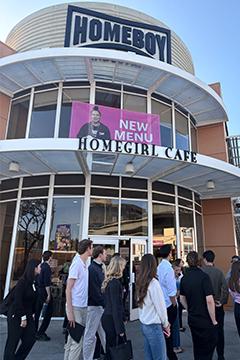 Students outside the Homegirl Café
Based in Los Angeles, Homeboy Industries is one of the largest rehabilitation and reentry programs for formerly incarcerated gang members in the world. Recognizing that many of these people come from poverty, neglect, and broken families, founder Father Greg Boyle considered a lasting remedy for redirection: to be cherished within a supportive community and given a practical job. He has notably said, “Cherishing is love with its sleeves rolled up.”
Homeboy Industries employs more than 300 people annually—all lovingly called “homeboys” or “homegirls”—within 16 of its small businesses as a step within its rehabilitation program. Such enterprises include a café, a podcast, clothing recovery shops, and even a dog grooming company, where members can earn a paycheck while rebuilding their lives and finding their God-given passions.
Throughout the semester, Schaffer’s students split into four groups, each partnering with one of these enterprises, working directly with homeboys and homegirls to help with any specific business needs. These tasks ranged from increasing profitability to restructuring team management and organization.
Prior to launching their projects this February, students took multiple visits to the nonprofit’s headquarters in Los Angeles for tours and to connect in person with their clients. The cohorts also met with Tom Vozzo, former CEO of Homeboy Industries, whose recently published book, The Homeboy Way: A Radical Approach to Business and Life, served as one of the course’s guiding texts.
“It's a full circle moment for me, as a professor who has loved Homeboy from afar, to now get to immerse an entire class in some really meaningful conversations,” says Schaffer. “A big part of this project is trying to learn the Homeboy way ourselves and apply it to our class.”
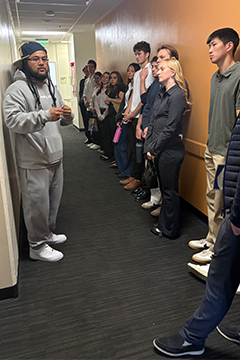 Each student group met with their Homeboy clients
Graduating business administration major Danny Berner worked closely with the industry's dog grooming business, Homeboy Puppy Fades. While analyzing the salon's current operations, including brand identity and clientele's likelihood of rebooking an appointment, Berner and his team developed a strategy to grow the business. With mindfulness of Homeboy’s mission of service and compassion, they developed a set of practical steps: increasing awareness in the Los Angeles area to welcome in new furry friends, strengthening brand messaging to develop loyal customers, and creating an efficient booking system.
“It is one thing to come up with ideas and marketing strategies, but it is another thing to connect them to not only what the client thinks is realistic, but also the Homeboy mission,” says Berner. “It was a great project to learn about how businesses can balance financial goals with meaningful social impact.”
Similarly psychology major Sedrie Orantes, who enrolled in Schaffer's course to fulfill requirements of her nonprofit minor, learned that ideas and marketing strategies need to be both realistic and in alignment with an organization’s credo. Working with the Homeboy Threads, Orantes’ team was tasked with creating marketing strategies so the organization could rise in popularity within the clothing resale sector.
Considering psychology as a critical driver of business success, particularly in mission-oriented industries that prioritize emotional awareness of both clients and employees, Orantes adds, “Joining a business capstone class from a different major built my confidence and helped me to see I’m more capable of working as a business consultant than I originally thought.”
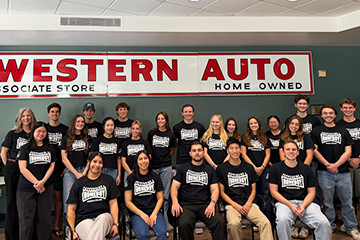 Reagan Schaffer's Servant Leadership course
Jumping into the trending industry of podcasting, senior Emily Ralph has worked on scaling the organization’s podcast, The Homeboy Way. Her clients pitched a simple request: “We want to be the best podcast in the world.” So, the team conducted market research and analyzed industry trends to craft compelling creative material for a range of audiences.
Ralph’s team found that the podcast’s greatest strength lay in its authenticity. In a society of social alienation, Homeboy’s mission is countercultural: redemption and grace are offered freely. A wide range of guests had appeared on the show to speak about how Homeboy relates to their lives ranging from Homeboy members to even actress and humanitarian Jane Fonda, who serves as a board member on the nonprofit.
To close out the semester, the students will be presenting final business strategies to their Homeboy clients. Here, their work will be put to the test. If enterprise staffers at Puppy Fades, Homeboy Threads, and The Homeboy Way like the students’ ideas, they will continue to implement them following the end of the formal partnership.
“I'm directly working with a nonprofit that's changing people's lives,” says Ralph. “And I see parallels of that during my senior year at Pepperdine. Dr. Schaffer’s direct investment to provide all of us this incredible opportunity and overall education has shaped my life for the better.”
SUBSCRIBE TO THE WAVELENGTH
Pepperdine Newsroom's official newsletter for campus updates and top news.
Subscribe