Seaver College Students Practice Restoring the Past Through 3D Printing Project at Genesis Lab
With brush and scalpel in hand, Seaver College student Grace Flynn examined a replica statuette of Dionysus. The Greek god of wine and festivity reclined in languor, with legs outstretched and head facing forward, but the figure was in need of repair. His forearms were missing, and upon closer inspection, Flynn observed his nose, too, was gone.
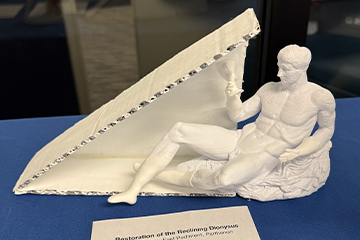 Flynn and Rodriguez's restoration project: Reclining Man, Dionysus
While closely mirroring the intricate detail required of museum conservation work, Flynn, along with her fellow students from World Art History I taught by Yoonah Hwang, assistant professor of art history, practiced the restoration of historical artifacts in an unconventinal way. Their work culminated in a final project titled: Restoring the Past Through 3D Printing.
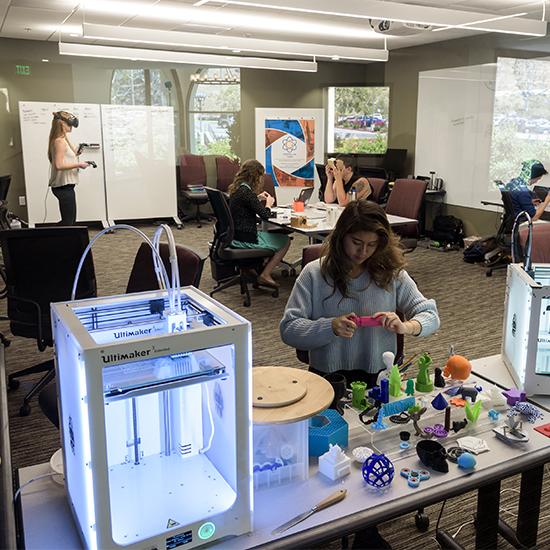
Hosted by Pepperdine Libraries’ Genesis Lab, Hwang’s students were tasked with selecting a historical art object they had studied in class and then used the Lab’s 3D printers to create models on a smaller scale. Many were damaged in their original form or required additional contextual elements to aid in understanding their historical significance.
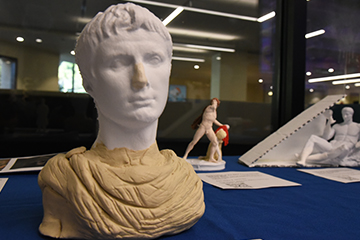 3D-printed bust of Emperor Augustus, restored nose and robe
With their 3D-printed artifacts now handheld, Hwang’s students worked in pairs to complete the restorations, each using materials such as acrylic paint and clay. Depending on the level of restoration required, some employed additional 3D modeling software. Having chosen the figure of Dionysus, Flynn and her co-restorer, Gerardo Martinez Rodriguez, carefully shaped new limbs and a replacement nose out of modeling clay. Deciding to add an extra contextual element for viewers, Flynn also sculpted a wine vessel for the Greek god to hold.
“This project was a lot of fun, and it was a great opportunity to apply the knowledge we gained in class with hands-on technology,” Flynn reflects. “I enjoyed the challenge of trying to match my restoration additions with what I think the artwork originally looked like, even if it took a few tries! It was also cool to see the 3D-printed artwork; it was like having a mini masterpiece in my hands.”
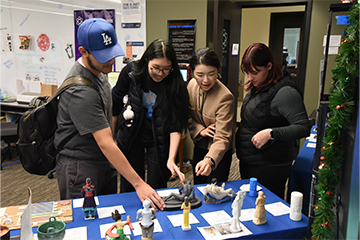 Hwang and her students discuss 3D-printed restorations
Hwang shares that all restoration decisions were supported by historical research. Throughout the semester students considered societal values and religious significance when studying historical art pieces. Accordingly, when it came time for this project, they were equipped with the knowledge to bring an object back to life in a way that honors its original purpose and significance.
To celebrate students’ restoration work, on Tuesday, December 2, Genesis Lab hosted a pop-up exhibition. Each completed project was displayed around the room, as students invited their friends to not only view, but interact with their work. Unlike fragile works typically seen in galleries, the students’ restored pieces invited hands-on engagement. Exhibition guests were encouraged, for example, to roll a restored Mesopotamian seal into a play dough to see its impression or feel the surface of a Chinese bronze vessel to understand its design.
Through supporting faculty as they implement emerging technology in the classroom, including 3D printers and virtual reality devices, Pepperdine Libraries’ Genesis Lab continues to bolster experiential learning opportunities.
“In this way, the Restoring the Past Through 3D Printing project encouraged a deeper appreciation of historical objects from the dual perspective of creator and viewer,” explains Hwang. “It also offered a fun yet deeply meaningful way for students to both explore a historical object’s original context and experience museum-style restoration work.”
SUBSCRIBE TO THE WAVELENGTH
Pepperdine Newsroom's official newsletter for campus updates and top news.
Subscribe