Biology Professor Javier Monzón Investigates Microbiomes of the Lone Star Tick Living Across the United States
Carbon dioxide from a mammal’s breath sets a lone star tick’s senses ablaze. Perched on blades of grass or clandestine within dense underbrush, these ticks actively pursue their hosts, feeling for the vibration of walking or detecting the presence of carbon dioxide to cue that a mammal is near.
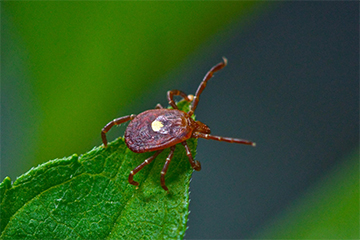 Lone star tick
As a single bite from this bloodthirsty creature can lead to a number of illnesses, including bacterial infections and the onset of a life-threatening red meat allergy called Alpha-gal Syndrome, the quest for tick control is ongoing.
Yet the variety of bacteria inside a tick goes beyond disease-causing pathogens; the microbiome also includes symbiotic bacteria inhabiting its gastrointestinal system that work internally to support a tick’s health.
Seeing a potential path toward developing new strategies to reduce the incidence of tick-borne diseases by disrupting their beneficial bacteria, Javier Monzón, associate professor of biology at Seaver College, conducted a study on the species’ microbiomes—the largest of its kind using advanced DNA sequencing to discern exactly which bacteria were living inside.
“The lone star tick is a very aggressive species that poses a risk for both animals and people,” says Monzón. “It is aggressive in two senses: (1) it actually pursues a host, and (2) once it finds a host, it will most likely bite it because it has very low host-specificity. A lone star tick is not picky and will bite anything from birds and mammals to reptiles and humans, therefore species control is a concern.”
Capturing Specimens
Monzón’s research began with his boots on the ground in a hunt for this infamous lone star tick.
To the relief of Malibu locals, lone star ticks are absent in California. As a result, Monzón, along with two Seaver College student research assistants, Lawson Trimmell and Peter Briggs, had to travel across the United States to collect samples in Oklahoma, New York, and New Jersey state parks. Because the species has expanded considerably westward and northward from its original mainstay of the American Southeast, Monzón considered a sampling of ticks from these states to capture the species at its two fronts of range expansion.
Monzón and his research assistants intrepidly entered the most tick-infested areas, which necessitated thorough covering from head to toe. Then the trio used two different collection methods: dragging and CO2 trapping. The former entailed dragging a white cloth over grass to catch ticks as they clung to the passing material. The latter involved placing a chunk of dry ice (solid carbon dioxide) in a styrofoam cooler punctured with four holes on each side. The cooler was then set atop a white cloth and surrounded by double-sided tape. As carbon dioxide disseminated out of the holes, it mimicked the chemical makeup of a mammal’s exhale—beckoning nearby lone star ticks, which would get stuck on the sticky tape
“A tick is tricked into thinking the CO2 trap is a mammal,” says Monzón. “This method of catching lone star ticks works primarily on this species because they are an aggressive tick that actively searches for a host, whereas other species of ticks just wait for a host to pass by.”
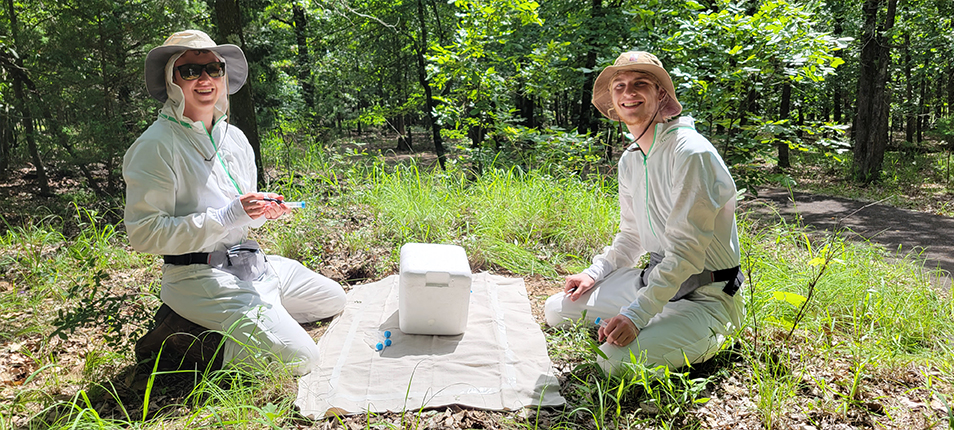 Lawson Trimmell (left) and Peter Briggs (right) with their CO2 trap for lone star
ticks
Lawson Trimmell (left) and Peter Briggs (right) with their CO2 trap for lone star
ticks
With the combination of these techniques, Monzón and his team collected a grand number of 1,954 ticks in six days of field work.
Back in the Lab
Preserved alive in plastic tubes, these little vermin made their way to the Monzón lab in Malibu.
The microbiome of a tick is a cocktail of bacteria—some beneficial and some causing disease. The beneficial bacteria provide immune system support and even break down nutrients in the ticks’ digestive tracts. This gave rise to the question: What is the role of each species of bacteria present in the ticks’ microbiomes? Enter the expertise of Leah Stiemsma, associate professor of biology at Seaver College.
Specializing in microbiology and microbiome science, Stiemsma collaborated with Monzón to analyze gene sequences of each bacteria to better understand their type and function. Across two very distinct geographic regions—from the plains of Oklahoma to the coastal northeast of New Jersey and New York—Monzón found that male ticks had a wider variety of bacteria as opposed to their female counterparts. The more diverse microbiome of males is likely due to the discovered dominance of a certain Coxiella strain in the microbiome of female lone star ticks, Monzón explains.
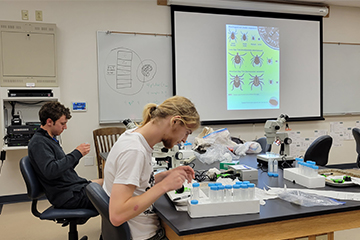 Trimmell and Briggs in the Monzón lab
Coxiella functions in synthesizing B vitamins (B1, B2, B3, and B5), contributing to a tick’s overall health. According to Monzón, the higher number of Coxiella-associated metabolic pathways in female ticks suggests that females depend on Coxiella for their well-being more than males.
“B vitamins are largely absent in a blood-based diet and lone star ticks are incapable of synthesizing them de novo, so they must rely on bacteria to make up for this nutritional deficiency,” says Monzón.
These findings reveal a deeper understanding of the relationship between ticks and symbiotic bacteria, propelling the potential development of brand new methods of tick control.
The Future Potential
Currently, if one thinks about methods of tick control, what comes to mind is pesticides. “And exposure to those chemicals isn’t good for anyone,” says Monzón. “Pesticides that kill ticks are also toxic to other arthropods that are beneficial to us.”
This new research points to a different solution: disrupting bacteria ticks rely upon for nutrient and vitamin synthesis. “Now that we discovered how some bacteria can help ticks, we can manipulate that relationship. If we remove these beneficial bacteria from ticks, their numbers may decrease,” adds Monzón.
Furthermore, Monzón’s research interests extend to a variety of species beyond ticks. From canaries and golden eagles to western fence lizards, the biology professor considers studying the ecology of a variety of animals to be his God-given purpose. While receiving his PhD in ecology and evolution at Stony Brook University in New York, he authored his dissertation on northeastern coyotes—which he has expanded into further studies since joining Seaver College as faculty—and also pursued postdoctoral research on the lone star tick.
Though ticks may find themselves with a wealth of human attention because they can make us sick—and fearful of getting sick—Monzón’s discoveries may serve to lessen the brazen lone star tick’s presence out in the fields and underbrush sometime soon.
SUBSCRIBE TO THE WAVELENGTH
Pepperdine Newsroom's official newsletter for campus updates and top news.
Subscribe