Biology Professor Javier Monzón Investigates How Urbanization Shapes Coyote Behavior
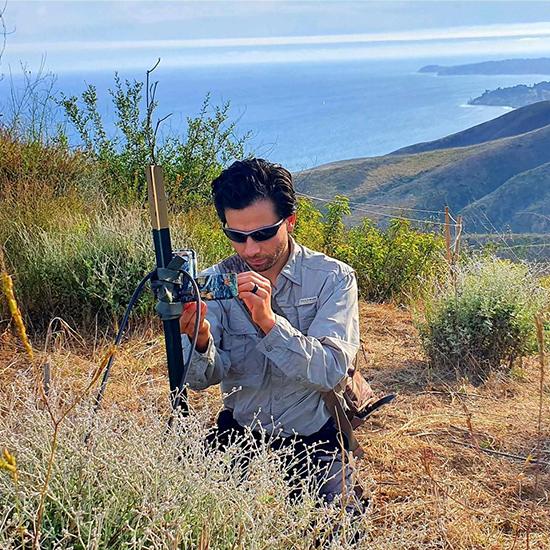
With their tawny snouts poking through the chaparral, coyotes have long inhabited the Santa Monica Mountains. But as cityscapes and bustling highways have expanded across the Los Angeles area throughout recent decades, coyotes once tucked away in the wilderness have adjusted to the changes in their landscape—that is becoming more cavalier and appearing frequently in developed areas.
Newly published research by Javier Monzón, associate professor of biology at Seaver College, and ecologist Lucian Himes (’23) has confirmed this notion, specifically that coyotes in urban areas have become less cautious as compared with their skittish rural counterparts. Effects of this behavior vary from increased daytime sightings to a heightened propensity for urban coyotes to consume new foods not found in the wild.
Part of a nationwide experiment conducted by 33 scientists across the United States, Monzón and Himes represented the region of Los Angeles. As a whole, the study aimed to determine whether coyotes in urban environments exhibit behavioral changes, while also comparing coyote populations on the West Coast with those on the East Coast.
 Javier Monzón
“Coyotes are a polarizing animal,” says Monzón. “But we chose this species to investigate how cities impact the evolution and ecology of wildlife because the coyote is a great example of being a ‘habitat generalist.’ This means that they are not picky about where they live, so we could study them in almost any city in the continental United States and adjacent rural areas.”
The first step of Monzón and Himes’s research was to lace up their hiking shoes and traverse into Pepperdine University’s backyard: the Santa Monica Mountains. The team planted wooden posts into the dirt and tied them together with rope to create novel objects unfamiliar to a coyote’s natural habitat, placed a spoonful of meat as bait in the middle of the posts, and filmed the animal’s various reactions with “camera traps”—remotely triggered digital cameras used to monitor wildlife.
Camera locations ranged from deep in the Santa Monica Mountains and Simi Hills, where coyotes often do not come into contact with civilization, to areas near Malibu homes and the Pepperdine campus itself. With this variety, Monzón and Himes could compare urban and rural coyotes in the Los Angeles area before taking their datasets to the nationwide group, which studied the species in other cities, such as Denver, Raleigh, and even New York City.
All 33 researchers measured four components of the coyote behavior at a combined total of 623 camera-trap sites. First, they allotted the amount of coyote detections—the number of times coyotes visited the site. Second, they tracked coyote visitation time: meaning how long the animal spent in front of the camera interacting with the wooden posts and bait. Furthermore, the researchers measured the distance the coyotes kept between themselves and the bait. Lastly, the scientists recorded the coyotes’ behavioral state.
“We were analyzing the body language of the animal to interpret what it might have been feeling when encountering the bait surrounded by the novel object,” Monzón explains. “Was the coyote curious, comfortable, or fearful?”
Afterward Monzón and Himes convened with the study’s researchers from across the nation to consider a consensus. Data across 16 pairs of cities and rural areas, from West to East Coast, confirmed that urban coyotes tended to get closer to the bait despite the posts than those living in less-developed areas. They found the behavioral trend that urban coyotes approach the novel object with more curiosity or comfortability as opposed to fear.
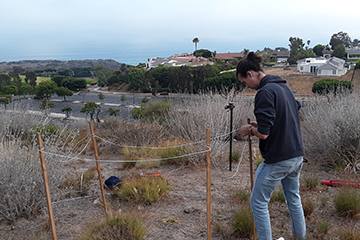 Lucian Himes setting up a camera trap near Malibu homes
Monzón explains that evidently urban coyotes have become accustomed to interacting with objects and people not originally found in their natural habitat. The biologists emphasize that these coyotes have not become more aggressive. They are simply more brazen, which means the urban coyotes might come into closer proximity to people, their homes, and their pets.
Considering that many major cities in the United States have formal coyote management plans to promote civilian and pet safety, Monzón posits that findings of this nationwide study can be practically purposed toward better management approaches.
“We confirmed that urbanization has altered the ecology and behavior of coyotes across the nation,” says Monzón. “Broadly speaking, we learned how animals change when they are faced with new conditions, and these changes are very likely similar for a whole suite of other urban-tolerant wildlife.”
Overall, Monzón and Himes have both solidified themselves as valued ecologists, serving both local and global environments. Recently, Monzón’s aforementioned research insights were featured in a PBS documentary on urban coyotes. Meanwhile Himes received a Fulbright Scholarship to study tropical coastal ecology in Papua New Guinea after completing his studies at Seaver College. He now works as a biologist and assistant project manager at Wildscape Restoration Incorporated, an organization focused on natural habitat restoration.
Monzón’s research interests extend to a variety of animals beyond coyotes. From canaries and golden eagles to western fence lizards, the biology professor considers studying the ecology of a variety of animals—many often overlooked such as the coyote—to be his God-given purpose. While receiving his PhD in ecology and evolution at Stony Brook University in New York, he authored his dissertation on northeastern coyotes and later pursued postdoctoral research on the lone star tick.
“Creation includes each animal and plant that God created. In Genesis, when God looked upon them, he called them good,” says Monzón. “As a Christian, I feel a calling to better understand and protect the animals God left under our care.”
SUBSCRIBE TO THE WAVELENGTH
Pepperdine Newsroom's official newsletter for campus updates and top news.
Subscribe