SURB Program at Seaver College Continues Tradition of Investigating the Natural World
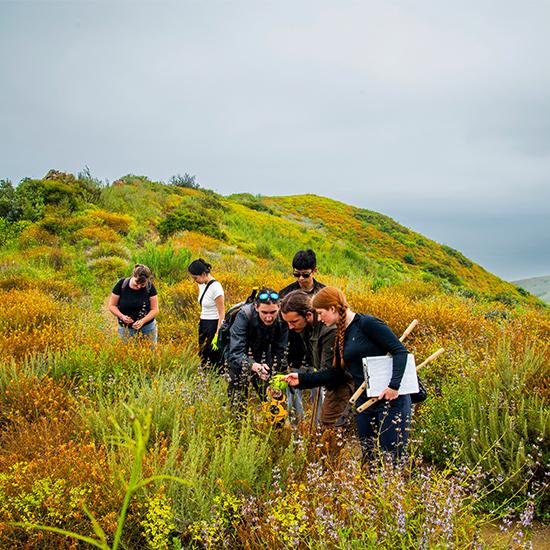
From studying the anatomy of drought-resilient resurrection ferns to cataloging the growing population of Pacific chorus frogs—among a multitude of other projects—Seaver College’s Summer Undergraduate Research Program in Biology (SURB) maintains deep investigation of our natural world.
Running for 10 weeks from May 17 through July 25, 2026, this year’s program brings nine mentors to support the development of 11 students into scientific thinkers while they execute a variety of research projects. Open to Seaver students as well as undergraduates from neighboring institutions interested in pursuing a career in biological research, SURB is helmed by program director Courtney Davis, professor of mathematics, with leadership support from codirector Helen Holmlund, assistant professor of biology.
“Our SURB students are not only learning about what scientific research is, but they are also contributing to the greater scientific body of work,” says Davis, while remarking that around 80 percent of SURB alumni are propelled to pursue scientific careers, obtaining grants and presenting at academic conferences worldwide.
SURB operates like a miniature scientific community. Within the first two weeks of the program students are already forming written proposals on their selected research projects. Then during a dedicated retreat off-site, students present their ideas as oral presentations and receive detailed feedback, enabling them to refine their hypotheses and enter weeks of hands-on research with well-developed plans.
Davis remarks that SURB endeavors to train students how to become effective communicators within their given fields, as precise scientific writing is required for publishing in journals, writing grants, and reviewing the work of peers.
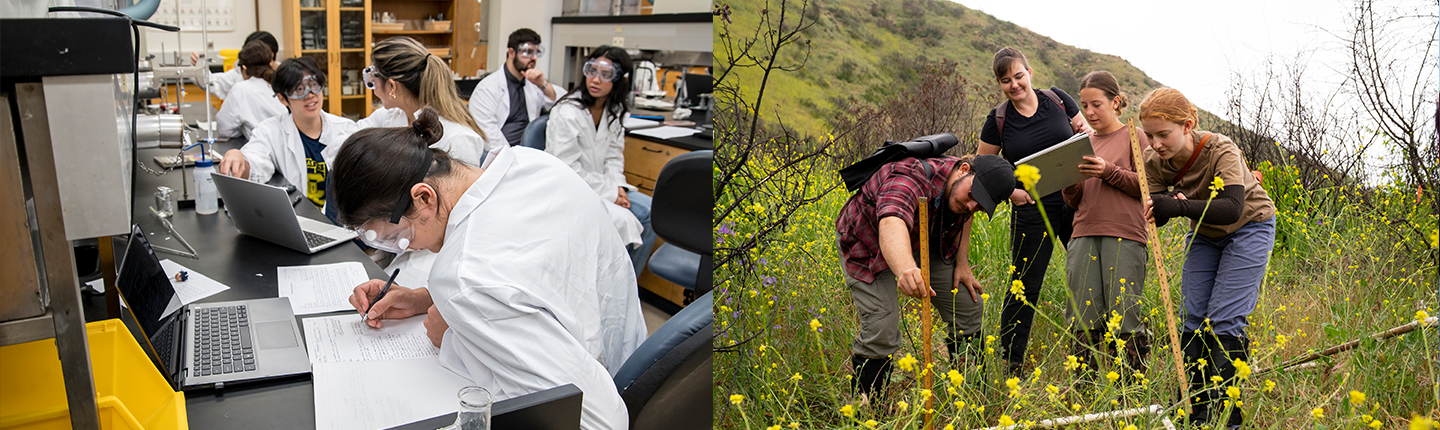 SURB students conduct research in Seaver laboratories as well as out on the field
Offering a glimpse into the robust research SURB students are engaged in this summer, Davis and her team of two students—one from Seaver College and one from an external institution—are mathematically modeling the impact of drought and aquatic predators on native amphibious species within local Malibu streams, such as the Pacific chorus frog. This research builds upon years of data collection, as students and their mentors alike continue to build conservation strategies.
Meanwhile Holmlund’s team will be investigating the anatomy of resurrection ferns, found within Pepperdine’s backyard of the coastal Santa Monica Mountains. While gathering samples for laboratory examination, Holmlund’s team is also investigating what factors have led certain species to be desiccation tolerant (able to revive after complete water loss) as opposed to those that perish under harsh water deprivation. Throughout the summer, the team will expand its reach across the world and travel to New Zealand to conduct similar sampling across mountain ecosystems there.
“Undergraduate students who have done research are strongly encouraged to apply for funding opportunities and graduate school,” Davis explains. “They’re in great demand because they’re bringing an idea to the table that has the credibility of being previously funded through SURB.”
Funded by the National Science Foundation, each admitted applicant is provided a generous stipend, on-campus housing, a unit of biology research credit, funding for travel to Malibu, and a budget for the purchase of research supplies. The brainchild of Distinguished Professor Emeritus of Biology Stephen D. Davis; Dwayne Simmons, Cornelia Marschall Smith Endowed Professor in the Department of Biology and the Senior Director of STEM Initiatives at Baylor University; and Gary Thomas, SURB was founded in 1987, blossoming throughout the years and garnering a network of successful alumni. Professor of biology Jay Brewster also served as a long-time SURB program director before transitioning to his role as University Provost. Subsequently Davis and Holmlund took the reins.
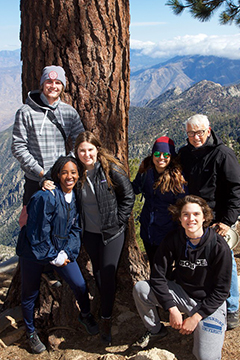 Karagan (middle left), Stephen D. Davis (back right)
In fact, Holmlund herself participated in SURB while a student under the mentorship of Stephen D. Davis. Then a student of veterinary science, Holmlund attests that “within 24 hours of doing research” as a SURB student, she had redirected her future vocation toward the study of chaparral and ferns. She also credits the program as the inciting incident for her whole career as a scientific researcher.
“What was so transformative to me about SURB was that I had never gotten to do the whole scientific process from start to finish before,” says Holmlund. “Hypothesis formation, field work, designing experiments were all new to me, and I loved every part of it. From then on, I knew that teaching and researching ecology was what I wanted to do.”
Recent alumna Karagan Smith (’20) also testifies to the powerful experience of conducting hands-on research. As her “first introduction to full-time research,” Smith testifies that the program is where she discovered her zeal for fire and plant ecology. Smith now celebrates the completion of a PhD in that field from the University of California, San Diego. Through devoted mentorship cultivated through SURB, Smith was led to apply for a Fulbright Research Scholarship which she pursued in Alicante, Spain, in 2021.
“Pepperdine’s SURB program was the foundation of my academic career,” says Smith. “There I realized that research was what I wanted to pursue after graduating from Pepperdine. Beyond the research experience, SURB also gave me lasting mentorship through the close relationships I built with faculty and equipped me with career skills that have carried me through every stage of my career.”
From field research through the boscage of the Santa Monica Mountains to the examination of specimens under a microscope, Pepperdine’s SURB students are immersing themselves in marvels of scientific research while finding both new discoveries, and themselves, in the process.
Interested in SURB for summer of 2027? Please visit here.
SUBSCRIBE TO THE WAVELENGTH
Pepperdine Newsroom's official newsletter for campus updates and top news.
Subscribe