Seaver College Student Milena Velez Presents at Harvard’s National Collegiate Research Conference
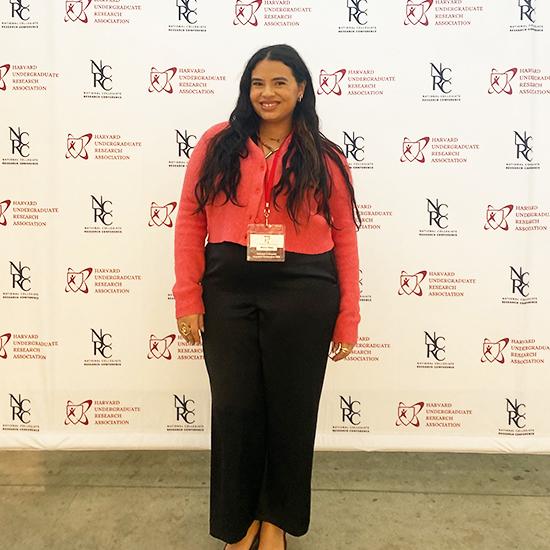
Milena Velez, an international studies and Italian studies major at Seaver College, presented research at Harvard’s National Collegiate Research Conference (NCRC) from January 23 to 25, 2026. Located at the Harvard University grounds in Cambridge, Massachusetts, the conference hosted undergraduates from more than 100 universities to dialogue with their colleagues, as well as with leaders in academia and industry.
NCRC is recognized as the nation’s largest student-run research conference. With the intent of promoting undergraduates early engagement with research, a poster session was held on January 24 at which Velez presented in the field of global politics.
She, along with fellow contributors, placed key findings of their studies and accompanying visuals onto large poster boards that were displayed throughout the university’s Northwest Building. All participants were encouraged to roam the vicinity and visit neighboring research stations.
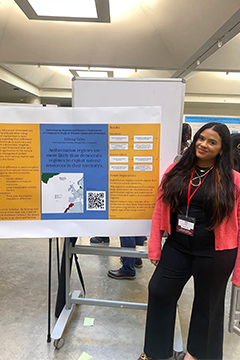 Velez sharing research at Harvard
“It was refreshing to discuss research with students in my own field of social sciences, along with those immersed in the humanities and even STEM fields who do cancer research,” Velez explains. “I feel I benefited from the opportunity to participate in a larger research community and to learn from the professors who talked with me while visiting my poster.”
Velez’s research involved a comparative analysis between Western Sahara and Greenland. Using large geographic size and unusual status as a territory as a common denominator, she conducted a comparative analysis of the two regions to further understand how their natural resources have been managed. The Western Sahara is currently a disputed territory under authoritarian rule, while, in contrast, Greenland is an autonomous territory within the democratic Danish Kingdom.
Through examining an often overlooked aspect of authoritarian regimes, Velez shares that her research contributes to a needed niche within the existing body of literature on characteristics of authoritarian regimes. Her research concluded that “authoritarian regimes have a higher tendency than democratic regimes to exploit natural resources in unsustainable ways.”
Throughout the process of gathering and analyzing data, Velez shares that she was mentored by Amanda Rizkallah, associate professor of international studies. “I really appreciate Milena’s creative, out-of-the-box thinking,” Rizkallah says, “as well as her willingness to be bold and take risks with her research questions.”
Velez's success reflects Seaver College's longstanding tradition of undergraduate research. These opportunities span across disciplines, including computer science, biology, classic literature, and international languages, while also involving interdisciplinary collaborations such as the recent work at the intersection of astrophysics and AI data-science.
Yet, beyond this research, Velez relays that Brittany Corbucci (’06), assistant instructor of Italian studies, has also been an important source of personal guidance during her time at Seaver. “Milena consistently challenges herself because she’s genuinely curious and deeply committed to learning,” Corbucci adds.
 Velez posing with her sorority sisters
On campus Velez is involved in many extracurricular roles. In addition to employment as a social media marketing manager for Pepperdine’s Campus Recreation club sports, she works to support student productions at Smother’s Theatre year-round.
As vice president of education for the Gamma Phi Beta sorority, Velez guides new members through the history of their chapter. And in preparation for NCRC, Velez recalls how her sorority sisters supported her while she composed her research deliverables, staying up late night after night to review her writing.
“You absolutely need community for healthy success,” says Velez. “Due to the love poured into me from my professors and sisters, I was able to confidently share my work at this research conference.”
SUBSCRIBE TO THE WAVELENGTH
Pepperdine Newsroom's official newsletter for campus updates and top news.
Subscribe