Seaver College Senior Jason Press Creates AI Software to Restore Data on the Aurora Borealis
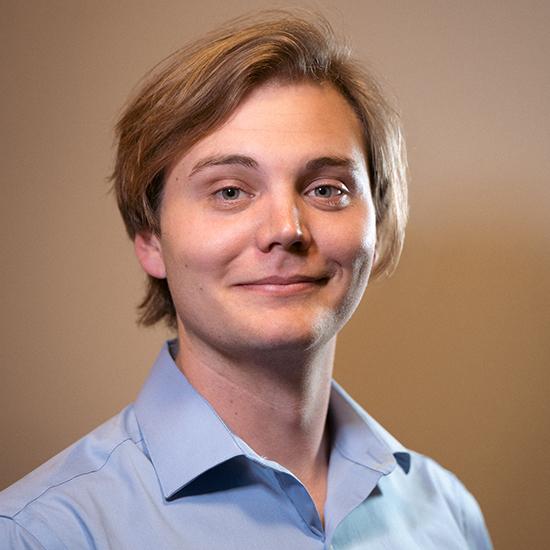
From as early as Jason Press can remember, he was always seeking to understand the inner workings of the world around him. From dissecting his family’s printer to discover how nozzles on ink cartridges spray precise lines, to creating ways to improvise within jazz scales, Press has rarely left a stone unturned.
During his years as a student at Seaver College, artificial intelligence rose to the fore of technology. Already immersed in computer science studies, Press sensed that integrating AI into scientific research was to be the next frontier, and he was determined to be among the first to develop something new.
Alongside Gerard Fasel, associate professor of physics and Fabien Scalzo, professor of computer science and director of the Artificial Intelligence in Imaging and Neuroscience Lab, Press soon found himself galvanizing a brand-new data recovery project merging the worlds of astrophysics and computer science. Its purpose? Training AI to recover years of video footage on the aurora borealis.
As a graduating senior soon to turn the tassel, Press reflects on the journey that led to the fruition of this AI software, informally named “Bordealis.” Not many undergraduates can say they’ve presented to NASA astrophysicists at the American Geophysical Union (AGU), one of the largest scientific conferences worldwide, or celebrated a first peer-reviewed journal publication while still an undergraduate—but Press can. Hands-on faculty mentorship that stewarded his boundless curiosity and commitment to innovation is what he says contributed to his success.
“It’s rewarding to see the skills I’ve developed at Pepperdine being applied in such a unique, interdisciplinary way,” says Press. “I know that it has been a dream of Dr. Fasel’s to be able to recover data, along with restoring new videos. Now with recent advances in AI, we can do that.”
Astrophysics Meets AI
During the Zhou dynasty, around 977 or 957 BC, the Chinese were the first to record sightings of the aurora borealis on bamboo annals, calling it a “five-colored light.” Meanwhile, the ancient Finnish, believing the aurora was a result of mythical foxes scampering across the heavenly fells, referred to them as “fox fires.”
Millennia ago, who would have thought that the aurora borealis could be used to predict space weather?
"When winds and storms from the Sun affect our Earth, it is called space weather,” explains Fasel. “We’d like to be able to forecast when we’re going to have a big burst of solar energy hit the Earth’s atmosphere.”
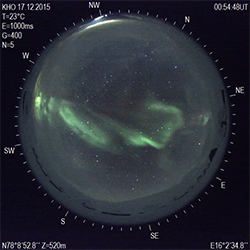 AI-restored image of an aurora
When unexpected, an eruption of solar energy could have adverse effects on Earth. For example, Fasel explains that the Carrington effect of 1859, the largest geomagnetic storm in recorded history, had tremendous impact; it led to widespread blackouts and sparked fires in telegraph wires globally. Intensely bright auroras were witnessed even in low-hemisphere locations such as Hawaii.
Considering that the aurora borealis is formed by these direct interactions between charged electrons in solar plasma and the Earth’s atmosphere, albeit often unthreatening, advancement in the understanding of space weather requires extensive examination of the patterns and irregularities present in footage of the aurora.
Fasel explains that he had contacted Scalzo to see whether emerging technologies could be used to recover his video data taken from the ground at the Kjell Henrickson Observatory in Norway. Cloudy days had previously obscured aurora light, leading to unusable footage.
Though AI’s abilities had previously been insufficiently developed to do so, in the summer of 2025 Scalzo said it could then be done.
Meanwhile, a certain ceaselessly inquisitive mind was enrolled in two of Scalzo’s computer science courses. And this would be none other than Jason Press. Taking advantage of Seaver College’s small faculty-to-student ratio, Press recounts how he was always “knocking on Dr. Scalzo’s office door” with questions ranging from computer science to brand-new projects he could be involved in.
One morning, Scalzo opened his door to find a bright-eyed Press standing on the other side. He said, “I want to work on research.”
To which Scalzo replied, “I have the perfect project for you.”
Building “Bordealis”
Crafting an entire AI software that accurately discerns auroral light from various cloud formations was a challenge, especially with no guiding playbook as it had never been done before. Press explains that Scalzo served as a valued mentor throughout the process, giving the young data scientist direction about certain algorithms to use and helpful advice on how to train the software.
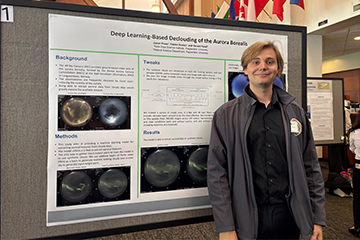 Press presented as Seaver's Research Symposium
Press began by presenting two different images to the AI software. One would be a real photo of the aurora borealis and the other would be altered with “fake clouds,” generated by using Perlin noise—a type of visual noise that can mimic the pattern of clouds. Starting with the most simple form of clouds, Press increased the complexity of the images over time.
“AI may seem instantaneous from the front end when we perform searches,” Press explains. “But the back end of actually programming the software can take months, and some projects can take years. If you move too quickly, there is a strong possibility of overshooting your goal.”
Since light from the aurora borealis is roughly distinguishable through the clouds, the model was able to understand the qualities of clouds and auroral light through comparison and by Press’ correction when he noticed an error. Little by little, Press’ course correction created a model that could receive a real cloudy image taken from the Kjell Henrickson Observatory and provide an image with restored aurora borealis.
“The achievements of Jason are particularly impressive; he has not only been brilliant in the classroom, but has also excelled in applying his knowledge to real-world problems,” says Scalzo. “In particular, his ability to immerse himself in a new field of science and leverage our GPU cluster [which allowed him to scale up the experiments and reach promising results] are exemplary.”
Though “Bordealis” is an ongoing project, Fasel shares that he is in the early stages of using the software to advance his research. Fittingly, in December of 2025, Press traveled with Fasel’s research team to New Orleans, Louisiana, to present “Bordealis” to panels of leading astrophysicists at AGU, explaining that interdisciplinary collaborations such as this open up pools of datasets for deeper understanding of space weather. No longer do cloudy days mean obsolete data.
“AI is a tool, and I hope to continue to make it more applicable to various fields. I do love the cross-disciplinary avenues of research such as this project,” Press admits. “I love having theories become applicable and seeing their wide impact.”
Seeking New Horizons
Though Press’ work has brought him to the world stage of AGU, as well as presenting at convenings such as the International Symposium on Visual Computing and the Seaver College Research Symposium, he encourages current students to never lose sight of their first motivators of curiosity and creativity.
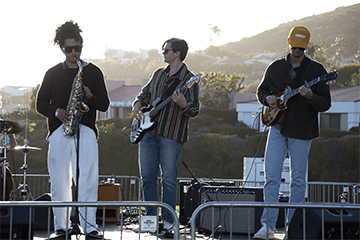 It's important for Press (middle) to have mulitple creative outlets
Referring to programming AI software as “one giant logic puzzle,” Press further explains that out-of-the-box thinking within the right parameters is what leads to brand-new innovations. He not only employs this skill on a screen, but also while creating music. Press is known to play the bass at events on campus, considering his musical outlet to enhance scientific thought.
“Whether you’re involved in science or art, you need to think creatively to make an impact,” says Press. “When you do something new, before you have the final product people are going to say it can’t be done. But music taught me how to break the right rules, which is what we did with this aurora project.” .
Looking ahead, Press plans to pursue a PhD program in computer science, seeking to continue to break new ground in AI technology and research. Since “Bordealis” is an ongoing project that will remain housed at Seaver College, Press has appointed a new project leader, Advay Poddar, a fellow computer science major and trusted friend.
“Research is my calling,” says Press. “That provides me with many opportunities. But, quite frankly, none of this would have been possible if I hadn't come to Pepperdine and met Dr. Scalzo.”
SUBSCRIBE TO THE WAVELENGTH
Pepperdine Newsroom's official newsletter for campus updates and top news.
Subscribe