Pepperdine Libraries Hosts Traditional Chadō Japanese Tea Demonstration
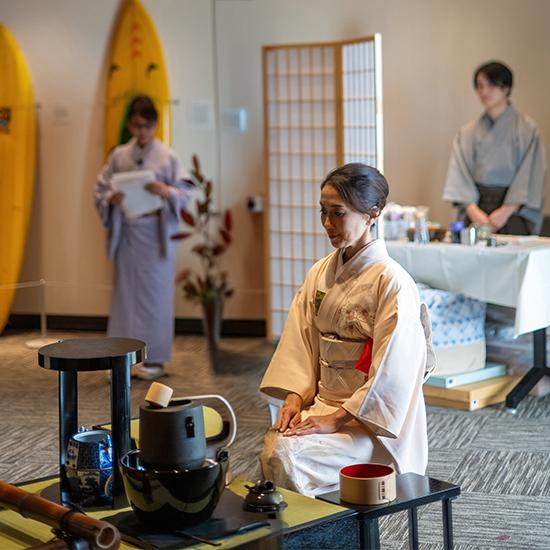
The traditional Japanese tea ceremony, chadō, transforms tea preparation into an art of living. In recognition of life’s transience, chadō’s meditative pace is grounded in disciplines of presence and gratitude for all within the teahouse. A warm cup of green tea is served with intentionality and sipped in repose, a ritual holding more than 450 years of history.
As part of Seaver College’s International Education Week, Pepperdine Libraries partnered with the International Studies and Languages Division to host a demonstration of chadō on November 20, 2025, at Payson Library’s Surfboard Room. The event proved to be a particularly valuable experience for students interested in the current Japan Perspectives program and the Kyoto program set to begin in the 2026–27 academic year.
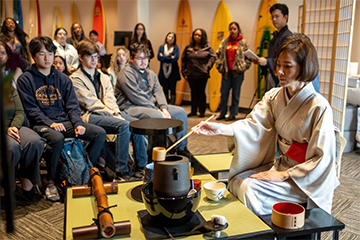 Tea preparation
Mike Sugimoto, professor of Asian studies at Seaver College, opened the ceremony. He later shared the history of how chadō tea rituals became a tradition embraced by Japan’s earliest Christian converts. The regard for mutual dignity among all tea ceremony participants, Sugimoto shared, created an avenue for religious freedom.
“In the 16th century, chadō's egalitarian vision—all were equal in the tea space—threatened the emerging dictatorship that was to rule Japan for 300 years,” Sugimoto explained. “The first Christian converts understood this, framing chadō as a Eucharist that overlapped with the first Mass in Kyoto.”
Tea master Yuko Uyesugi and students of the Urasenke School of chadō led three sequential tea demonstrations at Pepperdine, each of which detailed the precise steps of matcha preparation and the spiritual posture expected of both host and guests.
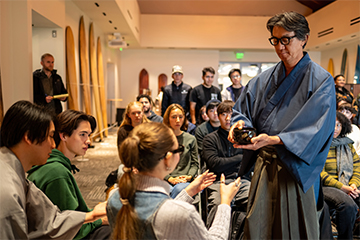 Seaver student receives a cup of tea
“The host purifies her mind and expresses her respect for the guests,” explained Sunao Sugita, Uyesugi’s student. “The tearoom should be very wide so we hear slow sounds of the water boiling.”
Sugita expressed the importance of purpose behind action, as each simple movement—from the whisking of matcha to the handling of teaware—is regarded as worthy of forethought and reverence. Upon receiving a cup of tea, members of the audience, including Pepperdine students, faculty, staff, and alumni were prompted to reply, “I will humbly have this tea.”
Attendees shared appreciation for a dedicated invitation to experience this long-lived practice. “I loved getting to see my culture and how exactly the ritualistic traditions are held,” said Tate Kolka, a current Seaver student of Japanese heritage.
“Perhaps the takeaway is that cultural influence is rarely linear,” Sugimoto explained, “but a network, where furthering one's knowledge of a distant practice bears upon something much closer to home.”
Read more about Pepperdine University's Kyoto Program here.
SUBSCRIBE TO THE WAVELENGTH
Pepperdine Newsroom's official newsletter for campus updates and top news.
Subscribe