Pepperdine University Announces Cybersecurity and Campus Safety Hackathon Winners
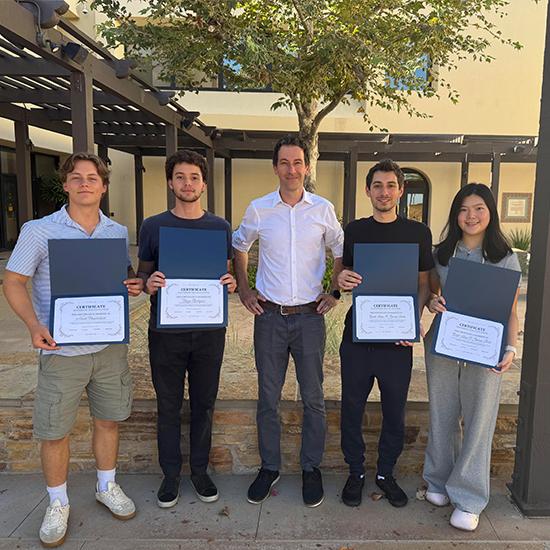
As technology continues to advance, so does the need for innovative ways to recognize and mitigate cyber threats. To this end, Pepperdine University, under the leadership of Fabien Scalzo, associate professor of computer science and director of the Keck Data Science Institute, hosted a second Cybersecurity & Campus Safety Hackathon from September 16–23, a competition reserved for Seaver College students to test their coding abilities to solve two separate prompts.
Held within the broader Human-Centered AI conference, Scalzo presented student participants with one question: In terms of cybersecurity, what would actually make a campus safer? Over the course of a week, students worked to solve this pressing question, competing in two tracks focused on emerging technological challenges.
"This event was a great opportunity for our students to showcase their technical skills on real-world problems,” says Scalzo. “It is exciting to see that they were able to achieve top quality submissions in less than one week. This is a testimony of the excellence of our students and their innovative mindsets."
The first prompt, Cyber Threat Awareness and Response, asked teams to develop tools that could help the students, staff, and faculty across all ages better recognize and respond to cyber threats. With AI increasing rates of phishing, or cyber attacks presented as a trusted source in order to gain personal information, as well as identity impersonation attacks, participants explored new ways to make identifying these threats easier.
Thiago Rodrigues, current computer science major, was named the winner for his interactive game designed to teach users how to identify scams and phishing attempts. The software operates by displaying a series of realistic emails and texts, which challenge participants to decipher legitimate messages from fraudulent ones. Following each round, the game explains red flags detected or missed, such as fake links, suspicious language, or baseless requests for personal information.
“What excited me the most was creating something people at Pepperdine could actually use,” Rodrigues said. “The main purpose of the game is to practice in a safe setting, where anyone can learn to recognize scams on their own when an email or text shows up in their inbox. It was meaningful to see a hackathon project help make our community a little safer, while learning a lot along the way.”
 Winners were presented with their certificates. Students L to R: Noah Vanderklok,
Yuki Shen, Zaven Silah, Thiago Rodrigues
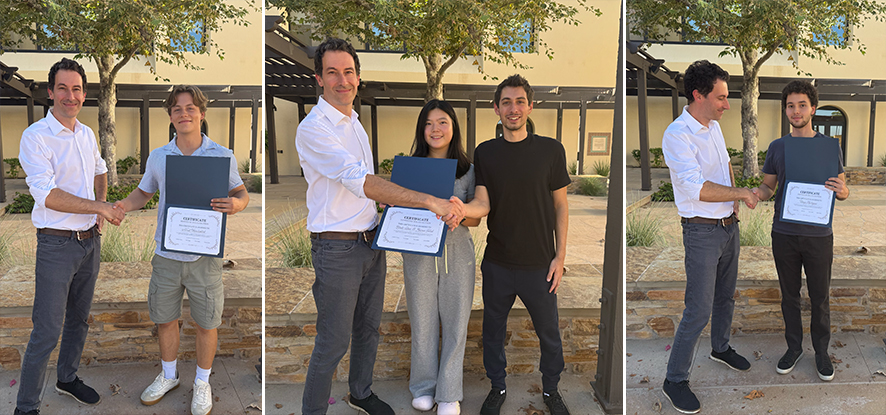
Winners were presented with their certificates. Students L to R: Noah Vanderklok,
Yuki Shen, Zaven Silah, Thiago Rodrigues
Noah Vanderklok, who is currently studying finance, and Zaven Silah, a computer science and philosophy major, were selected as finalists for the Cyber Threat Awareness and Response section.
The second track, Campus Safety Intelligence, challenged students to create software that allows public safety staff to sort through multiple reports of the same emergency. Such overlap can consume valuable time as security personnel work to determine which calls are duplicates and which represent separate events that need attention.
Students designed systems intended streamline these emergency responses, with Silah and Yuki Shen named the winners. The duo created a centralized platform that automatically identifies which reports are duplicates and which are new, while also assessing how urgent each event is.
"In an emergency, many people will often report the same event, and it takes our campus public safety valuable time to work out which calls are related,” says Shen, speaking on behalf of her team. “We wanted to streamline that with an AI-driven approach: a human still answers the calls.”
A valuable experiential learning opportunity for students, the competition offered a total cash prize of $5,000 generously provided by the Consulate of Israel in Los Angeles to be delegated among the winners. Beyond the laurels and recognition, students walked away with usable skills and a firsthand understanding of how technology can be used for the greater good of personal safety.
SUBSCRIBE TO THE WAVELENGTH
Pepperdine Newsroom's official newsletter for campus updates and top news.
Subscribe