SURB Research Areas
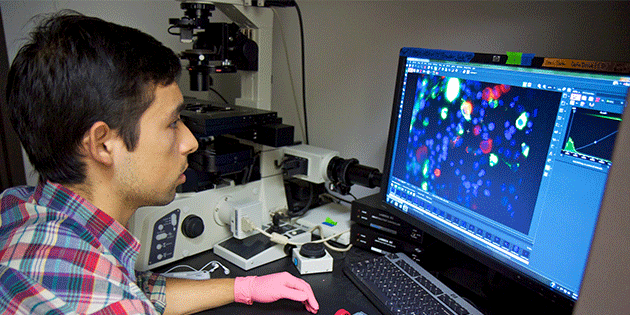
SURB faculty mentors vary by summer. The research areas of some of our SURB faculty mentors are detailed below. Other faculty conducting research in biochemistry, neuroscience, and other biological areas may also serve as SURB mentors depending on the summer.
Click the drop downs below to learn more about each research area and the professors leading it.
Animal Ecology: Molecular and Behavioral Ecology of Animals Living on the Edge - Dr. Javier Monzón
Research in the Monzón Laboratory focuses on the ecology, behavior, and evolution of animals that are living on the edge. We examine the ecological causes and evolutionary consequences of geographic range limits in various animals. We investigate the genetic and behavioral differences that arise in animal populations when they expand geographically or expand into urban areas. There are two ongoing lines of investigation: 1) behavioral ecology and population genetics of urban and non-urban coyotes in Southern California, and 2) behavioral ecology and population genetics of medically relevant ticks.
Microbial Genomics: Host-microbiome Interactions - Dr. Leah Stiemsma
Research in the Stiemsma laboratory focuses on host-microbiome interactions. We use genomics tools such as next-generation sequencing and quantitative PCR to analyze metagenomes (genes from many different organisms). We then use bioinformatics tools and regression modeling strategies to study interactions between microbes and their environment and/or host organism. Currently, we have two ongoing projects:
- Determining the role of the mammary tissue microbiome in breast cancer development.
- Characterizing the soil microbiome pre- and post-wildfire.
Cell Biology: Apoptosis and Cellular Stress Response - Dr. Jay Brewster
Research in my laboratory focuses on the initiation of stress-responsive and apoptotic programs in eukaryotic cells. The mechanisms through which cells adapt and respond to external and internal stresses are diverse and fascinating. Severe stress can activate a cellular suicide program known as apoptosis (programmed cell death). Entrance of a cell into apoptosis initiates a cascade of proteolytic events, culminating in the destruction of cellular macromolecules, membranes, and organelles by cytosolic and nuclear enzymes. Using mouse cells in tissue culture, we are currently characterizing the activation of cell death that results from abnormalities in the endoplasmic reticulum (ER). The loss of glycosylation activity during protein synthesis in the ER results in a dramatic apoptotic phenotype. Also of interest to our research group are the downstream targets of stress-activated signal transduction cascades (the genes being activated in response to cellular stress). We employ the budding yeast, Saccharomyces cerevisiae, as a model system for stress-activated signal transduction. We have recently cloned and are currently characterizing a set of genes that are activated by the HOG (high osmolarity glycerol response) signal transduction cascade following osmotic stress.
Mathematical Modeling of Biological Systems: Models of the Impact of Invasive Species on Native Populations in Southern California - Dr. Courtney Davis
Local ecologists have spent over twenty years studying amphibians, trout, and invasive crayfish in local Malibu streams. They have observed the decline of many native populations due in large part to drought and invasive predators. In collaboration with these biologists, we mathematically explore the impact of drought and crayfish predation on native species and investigate potential conservation strategies. We build and utilize a variety of mathematical approaches to describe these population dynamics and species interactions, such as discrete-time models, differential equations, or agent-based approaches. These mathematical models will be used to predict the long-term effects of California's drought on the local river ecosystem and to mathematically explore how intervention methods such as crayfish trapping affect native populations long term.
Plant Physiological Ecology: Environmental Stress Physiology of Plants Native to the Santa Monica Mountains - Dr. Helen Holmlund
Pepperdine's Malibu campus is nestled in the foothills of the Santa Monica Mountains, providing easy access to a natural laboratory of native plant communities. Our research combines physiological and ecological methods to study plant function within its ecological context. Most research projects will focus on eco-physiological adaptation to wildfire or summer drought. Some possible projects are: 1) the adaptive mechanisms of chaparral shrub species to survive periodic wildfires--seed germination, seedling survival, and resprout success, 2) mechanisms of shrub or fern drought tolerance--stomatal regulation, osmotic adjustment, and resistance of xylem to cavitation, 3) mechanisms of recovery in desiccation-tolerant “resurrection” ferns, and 4) survival strategies of the independent gametophyte generation in ferns.
Coastal Ecology: Effects of Land-based Pollutants on Coastal Communities - Dr. Florybeth La Valle
Peppedine’s campus is located on the scenic Malibu coast and provides a perfect location for coastal field community ecology. The La Valle lab research spans: the effects of urbanization and development on coastal communities, plastic pollution, coral reef ecology, effectiveness of marine protected areas, intertidal ecology, sustainable and equitable coastal practices, marine resource management, and data science. Dr. La Valle’s lab members can often be found both frolicking and struggling in the ocean, analyzing data in the lab, and practicing how to communicate their science to a wide range of audiences.
Epigenetics: Molecular Basis of Cell Identity - Dr. Antonio Gomez
Epigenetics is about how genetic information is interpreted by cells. A common analogy in biology is that DNA is the cookbook to creating an organism, and each gene is one of the recipes to create one of the components of cells (RNA, proteins, sugar, etc.). In that analogy, epigenetics is the way by which those recipes are read and interpreted by cells. The Gomez lab focuses on understanding the biochemistry of epigenetics as it relates to cell identity. Current areas of exploration include:
- The use of CRISPR epigenome editing technology to understand cell replication choice in cancer
- The role of noncoding RNAs in immune cell differentiation
- The effect of imprinting on neuronal cell function